Skin and Beauty Center
Open
- Open Monday - Saturday
11.00 AM - 9.00 PM
Sunday
11.00 AM - 7.00 PM
Contact Info
-
Contact: 02-466-9955
063-653-6236
063-653-6324
Treatment of skin diseases, Seborrheic Dermatitis, Atopic Dermatitis , Psoriasis, and Ringworm.
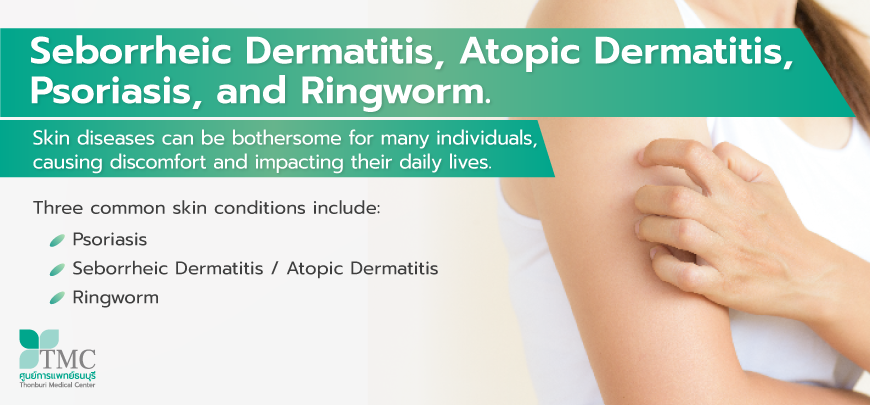
Treatment of Skin Diseases: Seborrheic Dermatitis, Psoriasis and Ringworm
Seborrheic dermatitis, psoriasis and ringworm are common skin diseases found frequently in Thailand. These conditions vary in severity and can affect daily life and self-confidence, as they are easily noticeable. Each disease has distinct symptoms and lesion characteristics.
Understanding "Seborrheic Dermatitis"
Seborrheic Dermatitis is a form of skin inflammation or sebaceous gland rash. It is a common skin condition caused by inflammation of the sebaceous glands, occurring in oily areas with many sebaceous glands such as the face, back, chest, nose, scalp, around the hips, and groin.
Symptoms of seborrheic dermatitis include:
• Oily skin patches covered with white or yellow flakes
• Red rash, peeling skin, burning and itching
• Inflamed, red, or crusted eyelids
• May accompany hair loss
• Symptoms may worsen under stress
• Often worsens in winter and summer seasons
Seborrheic dermatitis on eyelid
Seborrheic dermatitis on hairline
Seborrheic dermatitis on face
Seborrheic dermatitis cannot be permanently cured. Once symptoms improve, avoid irritants such as alcohol-based creams, manage stress, exercise regularly, and avoid alcohol to strengthen the immune system and prevent recurrence.
Understanding "Psoriasis"
Psoriasis is a common chronic inflammatory skin disease. It is easily recognized by thick red patches with white flakes resembling dandruff. Psoriasis usually starts on the scalp and spreads to other areas, most commonly the elbows and knees. Psoriasis is not contagious. Stress and insufficient rest are key triggers for flare-ups.
Symptoms of psoriasis include:
• Thick red patches with clear borders and heavy scaling on the trunk, arms, and legs
• Shallow pustules on red lesions
• Dry skin that may crack and bleed, with itching and burning
• Inflamed red patches in armpits, groin, or widespread redness across the body
• Nail abnormalities such as pitting, separation, or thickening
• Pain and swelling in joints
Psoriasis lesions on body
Psoriasis lesions on palms
Psoriasis lesions on scalp
Understanding "Ringworm"
Ringworm (Tinea / Dermatophytosis) is a fungal skin infection that can occur in all genders and ages. It is a curable condition. Ringworm can appear anywhere on the body including the scalp, face, hands, feet, nails, and groin. It appears as red-bordered rings on the skin, with the center having normal skin color.
Symptoms vary by location:
• Scalp ringworm — flaking scalp, pain on touch, patchy hair loss, itching
• Body ringworm — itching, redness, irritation around the ring, may develop blisters or pustules
• Athlete's foot (Hong Kong foot) — dry, itchy, red patches between toes
• Jock itch (groin ringworm) — reddish-brown, painful, blisters or pustules, itching
• Facial/neck ringworm — itching, swelling, dry scaling (doesn't form classic ring shape)
• Hand ringworm — thickening of skin on palms and between fingers
• Nail ringworm — white, cloudy, thick brittle fingernails; yellow, separating, brittle toenails
Ringworm on body
Ringworm on scalp
Ringworm on sole
How are Seborrheic Dermatitis, Psoriasis and Ringworm Different?
| Seborrheic Dermatitis | Psoriasis | Ringworm |
|---|---|---|
|
• Mostly found on scalp, face, between eyebrows, nasal folds (oily areas) • Rash appears moist and oily • Small yellow or white flakes • Not contagious |
• Mostly found on trunk, joints, elbows, knees (friction-prone areas) • Silver, shiny, dry, cracked scaly patches • Thick flakes, raised to the touch • Not contagious |
• Can occur anywhere on the body, especially in damp areas • Moist rash • Raised, red circular ring with normal skin in the center, itchy • Contagious through contact • More common in young children or the elderly |
Knowing the symptoms and differences between these conditions helps us identify and treat them correctly. Some can be cured completely; others can be managed to prevent spreading. Maintaining good health is essential to prevent recurrence.
Treatment
• Consult a doctor for diagnosis — for mild cases, topical and oral medications are recommended; severe cases may require injections
• Keep skin moisturized with gentle external products, anti-dandruff shampoo, and lotion
• Keep the affected area clean at all times
• Manage stress and get adequate rest
• Reduce irritation of affected skin, avoid scratching
Steps for Treatment at Thonburi Medical Center
1. Initial Consultation
You can consult us first by sending photos of the problem to Thonburi Medical Center via LINE Official Account (LINE ID: @tmc.center) for advice, appointment booking, and close follow-up.
2. Doctor Appointment
The doctor will evaluate your condition to find the most suitable treatment plan.
3. Result Follow-up
Most skin conditions improve within 2 weeks. Our staff will closely follow up on your treatment results.
Treatment Results
Free doctor consultation! Starting from 2,000 Baht
Booking an appointment and asking for more information at Thonburi Medical Center
As Thonburi Medical Center, we glad to give you a medical advice and we will properly provide you the services with our warm heart.